
Why Growth Curves Matter for NbS Carbon Projects
Carbon crediting in Nature-based Solutions (NbS) projects relies on two stages of quantification: ex-ante projections and ex-post verification.
Ex-ante modelling estimates future emission reductions or removals over the crediting period.
Ex-post monitoring measures realised performance and quantifies achieved emission reductions or removals against the applicable baseline.
In NbS projects where carbon sequestration depends on biomass accumulation, particularly in ARR (Afforestation, Reforestation and Revegetation) and Improved Forest Management (IFM), tree growth modelling underpins ex-ante projections. At the ex-post stage, the growth model can be tested and recalibrated against monitoring data to improve forecasts of future issuance.
In this context, the growth curve refers to the trajectory of stand-level biomass accumulation over time, whether modelled directly or derived from tree-level growth variables such as diameter at breast height (DBH), top height, or crown area.
As a result, the robustness of growth assumptions is central to carbon integrity. They determine not only the quantity of projected removals, but also confidence in the timing and scale of future credit issuance.
Growth Curves Anchor the Carbon Logic Chain
Taking ARR as an example, the carbon accounting logic is structurally linked to biological development: Tree growth → Aboveground biomass (AGB) → Belowground biomass (BGB) → Total carbon stock → Carbon stock change → Net GHG benefits → Carbon credits.
The growth trajectory determines:
The rate of biomass accumulation over time
The long-term carbon stock level and stabilisation pathway
Essentially, changes in the assumed growth trajectory translate directly into changes in projected carbon outcomes
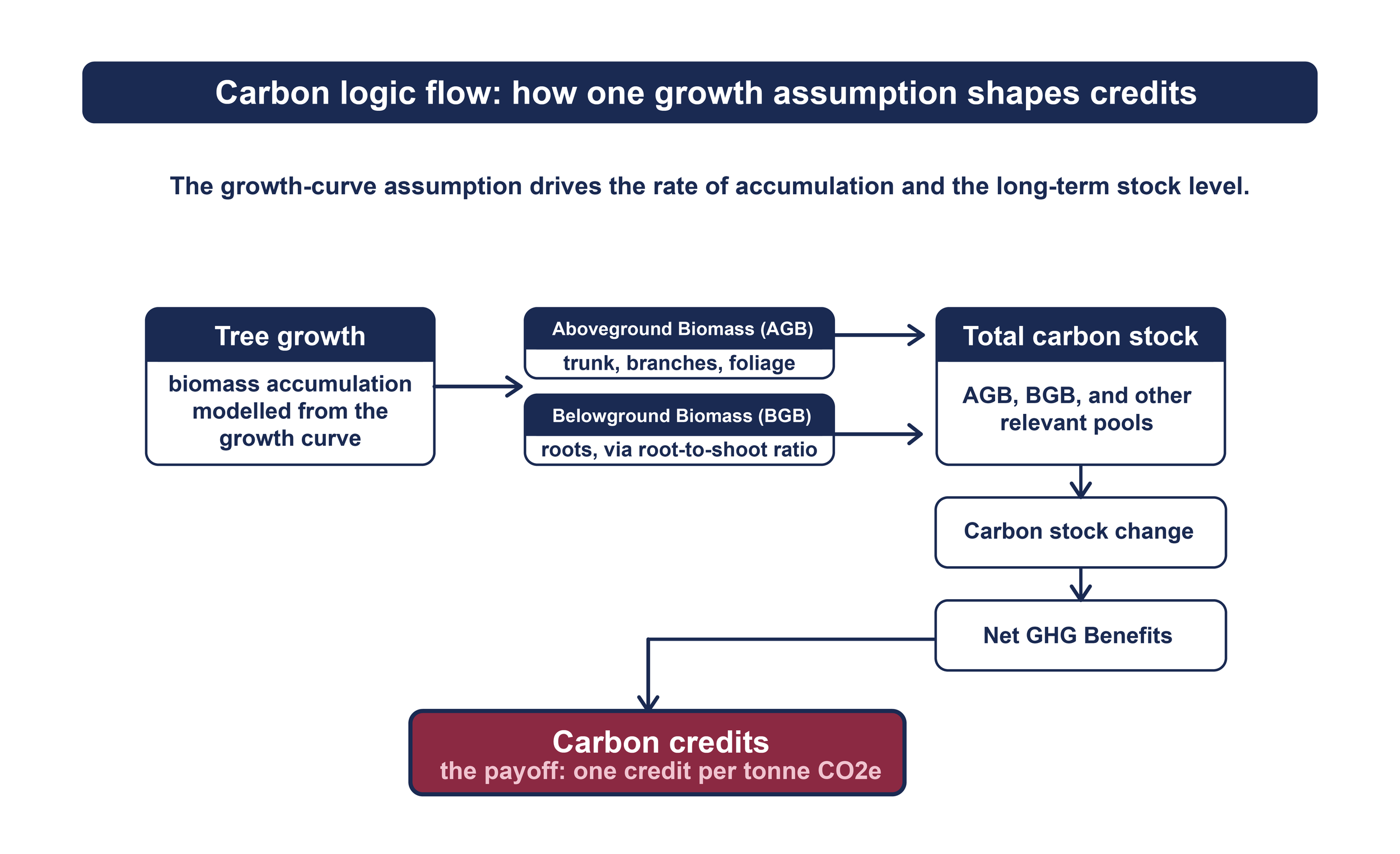
Figure 1. Carbon logic flow
Growth Modelling Influences Validation and Verification
At validation, growth assumptions are evaluated against scientific evidence, methodological requirements, conservativeness standards, and biological plausibility, where the latter refers to consistency with known species behaviour and site conditions. An aggressive early-growth trajectory may front-load credits; an inflated asymptote (reflective of the maximum achievable tree biomass) may overstate long-term removals in turn increasing the likelihood of validation queries, mandatory conservative adjustments, or rejection of the crediting scenario pending revised assumption.
At verification, the focus shifts from projected to realised performance. Credit issuance is based on monitored measurements and verified project outcomes, rather than the ex-ante growth trajectory itself. Where observed growth diverges from the modelled trajectory, monitoring data provide an empirical basis for recalibrating the growth curve and refine projections for the remaining years of the crediting period.
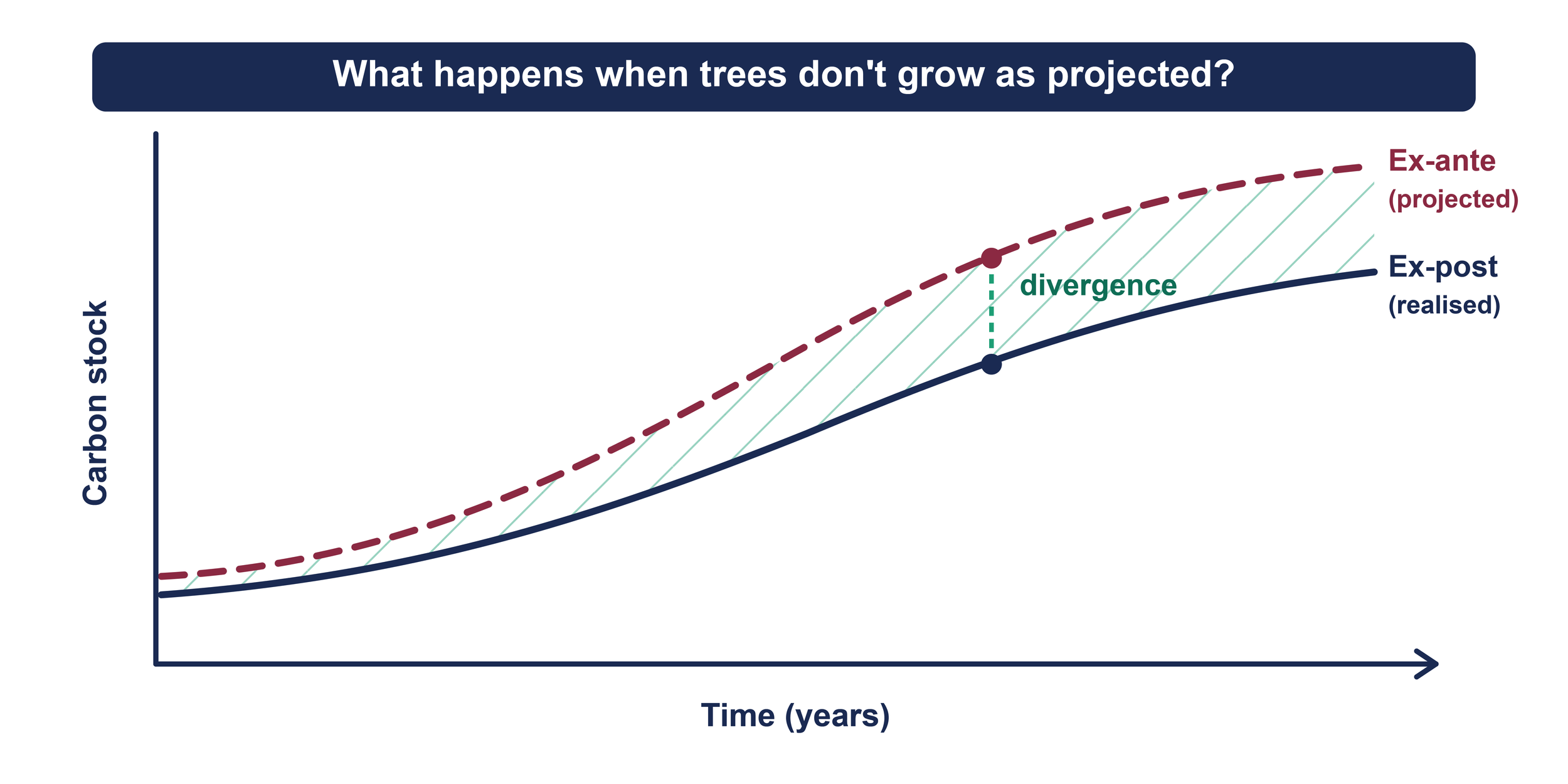
Figure 2. What happens when trees don’t grow as projected?
Growth Assumptions Affect Credit Delivery Risk and Commercial Outcomes
Growth assumptions influence how many credits are projected per monitoring period.
This directly affects:
Whether developers can reliably meet contracted delivery volumes
Whether buyers face volume shortfall risk due to overestimation of growth
Whether investors achieve expected financial returns where realised credit issuance deviates from initial projections
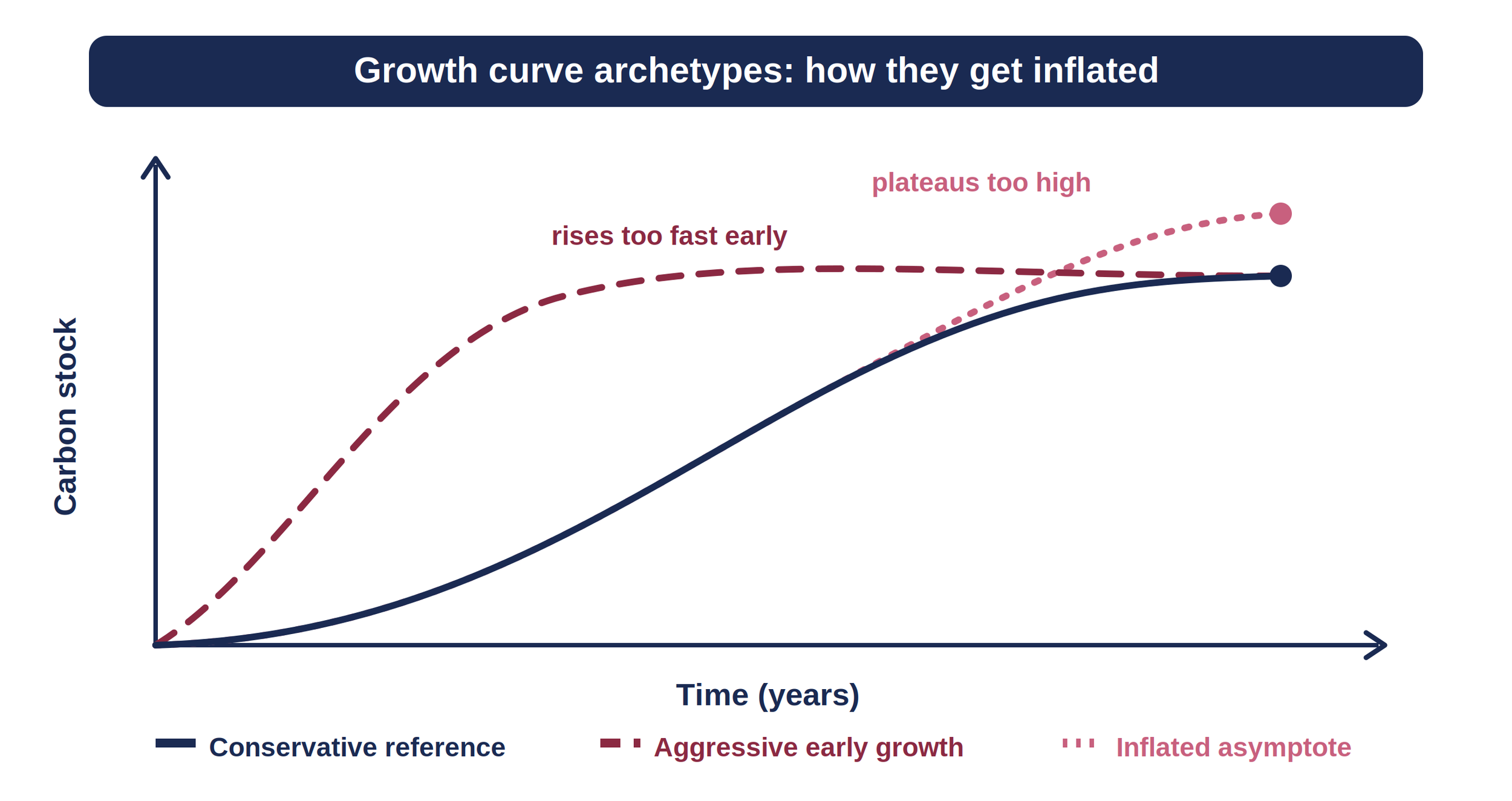
Figure 3. How growth curves get inflated
Over-optimistic growth assumptions may inflate projected credits ex-ante, while also creating a structural gap between projected and realised credit issuance. That gap increases the probability of delivery shortfalls and may lead to revisions of future issuance projections. As markets mature, consistency between projected and realised outcomes is therefore not only an integrity consideration, but also carries financial and operational implications, particularly where project revenues and cash-flow planning depend on expected issuance volumes.